Navico Sonic Hub: Next Gen Marine Entertainment
Enjoy plug-and-play simplicity when interfacing your main electronics suite with your onboard stereo—and then use the latest generation of navigation systems to choose your entertainment.
February 22, 2011
Marine stereos and entertainment systems have reached a new level with the development of Navico’s Sonic Hub, which is offered in versions for Navico nav systems by both Lowrance and Simrad. The Sonic Hub integrates entertainment and navigation with a little black box called the Sonic Hub Server. The Server is the brain; it connects with a waterproof (IP65) docking port and your MFD display, then gets the two units talking to each other in the same language—the language of music.
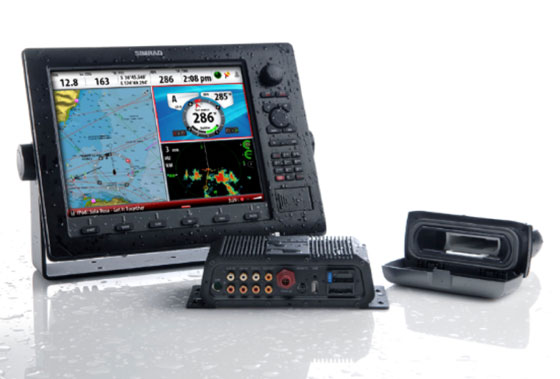
The docking port has a built-in AM/FM receiver and accepts the Apple iPod Touch, iPod Nano (Gen3-5) and iPod Classic (Gen5-7), as well as the iPhone, iPhone 3G and iPhone 3GS models, plus other USB MP3 players. Once you hitch it up to your MFD display (NSE displays in the case of Simrad, or HDS displays in the case of Lowrance), all of the controls for the Sonic Hub pop up on-screen, on a menu-driven bar that appears along the bottom of your MFD. Or MFDs, as the case may be, because this is the first system in the world which allows multi-station control of the entertainment system via your networked nav system. And yes, we do mean “entertainment” system. The Sonics hub has video as well as audio capabilities, so you can watch video in high-definition right at the helm, on the tuna tower, or wherever else you have an NSE or HDS display mounted.
The Sonic Hub puts out a throbbing 200 watts of power, divvying it up at 50 watts each over four channels, and it has multi-zone capabilities. You want to feel the bass throb like a trophy striped bass fighting on the end of your fishing line? No problem; the system also has a line-out for a subwoofer. If you have an active satellite radio account, it’ll also connect to Sirius via an AUX-in, and there’s another AUX-in for a CD/DVD/MP3 player.
While in some ways the Sonic Hub seems to fit the natural progression of modern electronics systems—you can already use an MFD to control pumps, monitor gauges or video cameras, and operate accessories like windlasses or thermal night-vision cameras, so why not entertainment systems as well?—the truly shocking thing about the Sonic Hub is its cost. I’d have expected to have to pay thousands for this sort of system, but a basic Simrad Sonic Hub package including the server, docking station, and SimNet adaptor cable MSRP’s at $399.
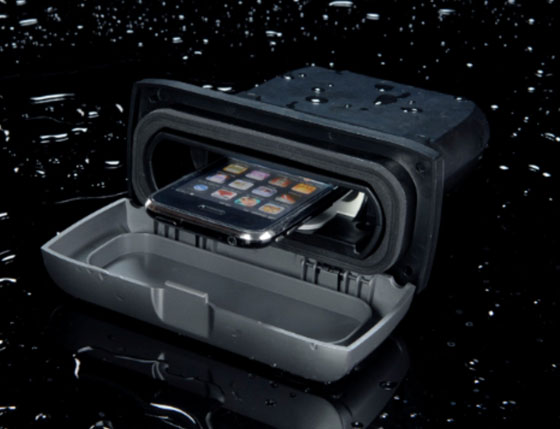
The Sonic Hub’s waterproof docking port protects land-based electronics.
The Lowrance system is scaled back a hair and doesn’t support video, but it goes for $100 less and comes with the audio server, docking station, NMEA 2000 adapter and six foot extension cable, plus a pair of 6.5 inch two-way marine speakers. These speakers will fit into most standard marine cut-outs. A pair of 6.5 inch two-ways doesn’t have the clarity or the powerful punch that serious music lovers are after, so you may want to upgrade them to enclosed coaxial or multiple-component speakers. (My favorite: Bose 151 SE environmental speakers. These are pretty expensive at a cost of $278, but they’re fully enclosed, easy to mount, sound incredible, and you can hit them with a direct blast of the raw water washdown hose without doing any damage).
My guess is that if you’re into your music, you’ll also want to add the sub-woofer—it makes a heck of a difference when you nail the throttles and have to fight wind noise with volume control. One other difference between the two systems: the Simrad can divvy out tunes to three zones, while the Lowrance is limited to two.
Using the Sonic Hub is exceptionally easy once you have it installed. The first one I tried playing with was on a rigged-to-the-teeth Yellowfin 35, which had a pair of 12-inch Simrad NSE displays at the helm. The menu bar was completely intuitive and without any directions, I was soon changing the radio station, switching to the iPod, bringing up satellite radio, and adjusting the volume. Will you ever have to resort to reading the instruction manual with the Sonic Hub? Not likely.
The sound quality was spectacular, the power was aplenty, and with my iPod sealed safely inside the Sonic Hub’s waterproof docking port, I didn’t have to suffer through the usual nervousness associated with bringing land-based electronics aboard a boat. Added bonus: unilke CDs iPods don’t skip, no matter how rough the seas. That meant that we enjoyed cool, crisp tunes as we bounced across the tops of three foot rollers, without interruption, with the controls on our MFD displays—something that was completely impossible, just one generation of electronic systems ago.
 Lenny Rudow has been a writer and editor in the marine field for over two decades and has authored five books. He runs his own web site at HookedOnFishingBoats.com and his syndicated blog appears at Boats.com in the BoaterMouth blog section.